English
Plant-Based
Tea's Plant-Based Ćevapi
Run the simulation in English and explore entrepreneurship and sustainable business through interactive decision-making.
Launch simulation →A collection of web-based games and simulations developed to help students and young entrepreneurs better understand modern business concepts — particularly in entrepreneurship and sustainable business.
Choose a simulation and run it directly in your browser. No registration or installation required.
Run the simulation in English and explore entrepreneurship and sustainable business through interactive decision-making.
Launch simulation →The Bosnian/Croatian/Serbian version of the simulation, intended for local students and educators.
Pokreni simulaciju →This website is designed as a place where learning and play meet.
It brings together a collection of web-based games and simulations developed to help students and young entrepreneurs better understand modern business concepts, particularly in the fields of entrepreneurship and sustainable business.
The simulations were created within the project "(Green) Entrepreneurship: Simulation of a Sustainable Business Environment for Developing Entrepreneurial Skills (ZEP)". Through these games, users can make decisions, analyse outcomes, and safely "make mistakes" within a controlled digital environment before facing the real market. The idea of the website is to support game-based learning and provide a concrete tool for educators, students, and anyone interested in exploring entrepreneurship in an interactive and engaging way.
The platform will continue to expand over time with new scenarios, modules, and games, ensuring that it remains a dynamic space for developing entrepreneurial competencies, critical thinking, and a responsible attitude toward the environment.
The project leader is Ljiljan Veselinović, Associate Professor at the Department of Microeconomics, University of Sarajevo – School of Economics and Business. As a researcher, he has published more than 40 scientific papers. He began his academic career in 2007 as a teaching assistant and is now an associate professor. He teaches courses such as Introduction to Business, Microeconomics, Managerial Economics, Game Theory, Labour Market Economics, Operations Management, and Urban Economics, and delivers instruction both in his native language and in English.
He continuously works on developing his pedagogical and didactic competencies. He completed the Lifelong Learning Programme in Pedagogy and Academic Staff Competency Development at the University of Sarajevo, as well as the DigiEdu training focused on creating high-quality, inclusive, and accessible higher education.
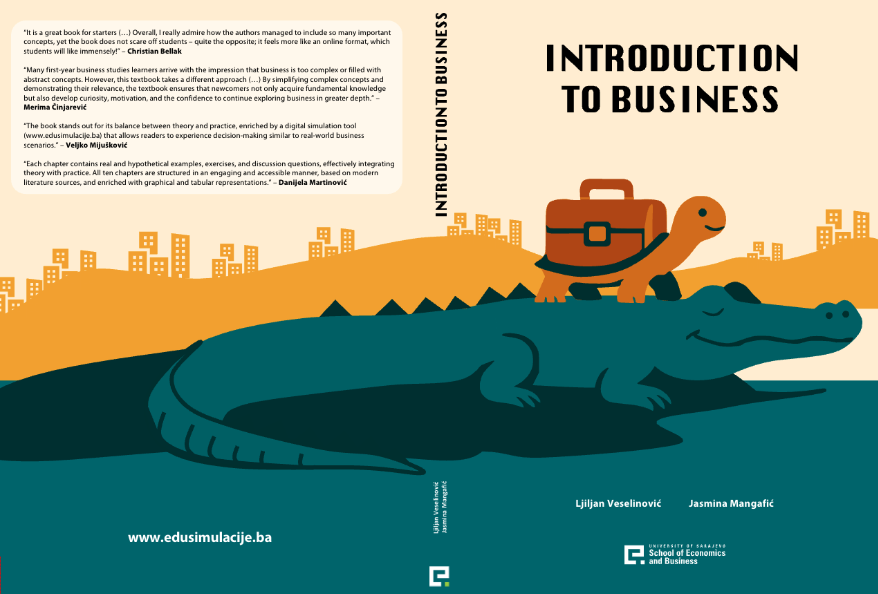
"Introduction to Business" is a modern guide to the world of business, written in a clear, accessible, and visually engaging style. Through real-life examples, interactive tasks, and digital simulations, the book helps students quickly understand key business concepts and develop the skills needed for decision-making in real environments.
It is ideal for new generations who prefer practical, dynamic learning supported by content tailored to contemporary study habits.
The platform is grounded in peer-reviewed research on digital game-based learning.
This paper explores how students experience digital game-based learning and which deeper values motivate them to engage with such learning environments. Using the Means–End Chain (MEC) theory and the soft laddering technique, the authors map the pathway from concrete elements of digital games (interactivity, simulations, adaptability) to psychological and functional benefits (engagement, knowledge retention, reduced anxiety), and ultimately to the personal values achieved by students (achievement, personal growth, autonomy, and happiness).
The study identifies four dominant motivational pathways (happiness-driven, achievement-driven, growth-driven, and autonomy-driven) and shows how digital learning activates key processes known in educational theories such as Cognitive Load Theory, Experiential Learning Theory, Situated Learning, and Self-Determination Theory.
This contribution is particularly important because it explains why digital games work in education — not just how and to what extent — opening possibilities for designing higher-quality educational games and developing personalised learning experiences.
Read the paper on DOI →"Introduction to Business"